How to Open a Store: Steps Before Your Opening
To open a store, write a plan, work out your startup costs, choose a business structure, pick a location that zoning allows, register the business, get a federal tax ID if you need one, obtain the licenses and permits your state and city require, arrange insurance, stock and staff, then set an opening date. Requirements vary by state and city, so confirm each step with the official source.

Part of our guide: Grand Opening: What It Is and How to Plan One
To open a store you move through planning, setup and opening, and the official steps differ by state and city. This page lays out the order and points to the official source for each step. When the setup is done, the grand opening guide and the full planning guide cover how to announce it.
General information, not legal, tax or licensing advice. Rules differ by country, state and city; check with your local authorities and a qualified adviser. Sign-off on 17 November 2026: the Grand Openings Guide team matched each claim to the sources listed below. The team holds no legal or licensing credential. See the editorial policy.
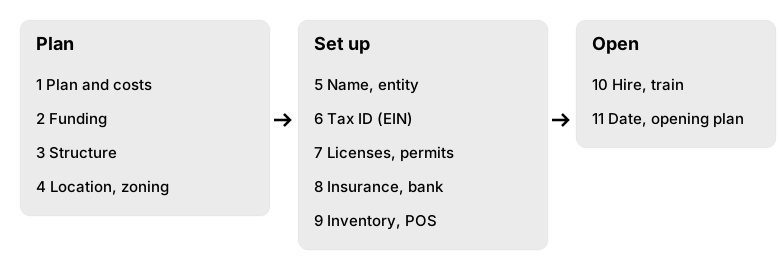
The steps in order
- Plan the business and estimate startup costs.
- Find funding if you need it.
- Choose a business structure.
- Pick a location and check zoning.
- Register the business name and entity.
- Get a federal tax ID (EIN) if you need one.
- Obtain licenses and permits.
- Arrange insurance and a business bank account.
- Source inventory, a point-of-sale system and suppliers.
- Hire and train staff.
- Set the opening date and plan the opening.
SBA’s business guide groups these into planning and launch stages. Treat the order as a guide: permits and location often decide your date, so start them early.
Business plan and funding
SBA calls the business plan the foundation of a business and a roadmap for running it. It describes a traditional plan (detailed, often requested by lenders and investors) and a lean plan (high-level, typically one page). SBA’s startup cost guidance separates one-time costs, such as equipment and permits, from ongoing monthly costs such as salaries, rent and utilities, and suggests counting at least a year of monthly expenses.
This page gives no cost figures. Your own quotes belong in your plan.
Choose a structure and register
SBA lists sole proprietorship, partnership, LLC, corporation and cooperative, and says the choice affects taxes, fundraising, paperwork and personal liability. It advises choosing carefully and talking to a business counselor, attorney or accountant.
You choose before you register with the state, and SBA says how and where you register depends on your structure and location. Most states register through the Secretary of State or a similar agency. SBA also notes that a trade name (DBA) may need its own registration, and that you do not typically register with the county or city just to form the business, though you may for licenses and permits.
EIN (federal tax ID)
The IRS describes an EIN as a federal tax ID for businesses, free from the IRS. You generally need one if you have employees or operate a partnership, LLC or corporation. The IRS also says you can request one for banking or state tax purposes.
Licenses, permits and occupancy
Ask three levels of authority, and ask early because approvals can set your opening date.
- Federal. Only certain activities need a federal license. SBA lists examples and the issuing agencies.
- State. SBA says states tend to regulate a broader range of activities than the federal government. Start with your Secretary of State’s website.
- City and county. SBA says local governments determine registration, licensing and permitting requirements. Ask about a business license, a certificate of occupancy or similar, fire inspection, signage rules and, for food, the health department.
This site does not state what your city requires. A selling space may also face rules about how many people can be inside at once, and your local fire authority can say how that applies. Never open to the public on the assumption that a trial day is exempt.
Location, lease and accessibility
SBA says your location choice depends in part on your target market, partners and preferences, and that costs such as rent, insurance, utilities and licenses vary by place. It also says neighborhoods are generally zoned commercial or residential, and that you should make sure a property conforms to local zoning before you buy, rent or build. Read a lease with a qualified adviser before signing.
Accessibility is part of opening to the public. ADA.gov says businesses open to the public must give people with disabilities an equal opportunity to use their goods and services, communicate effectively, allow service animals, and remove architectural barriers where that is readily achievable. New or altered buildings must follow the ADA Standards for Accessible Design.
Inventory, point of sale and suppliers
Choose what you will stock and from whom, and test your checkout before customers do. A point-of-sale system should handle your payment methods, receipts, returns and end-of-day counts. Ask each supplier about lead times and minimums, and write the answers into your plan. See the retail soft opening checklist for how to test these in a quiet first week.
Insurance and banking
SBA lists general liability, commercial property, product liability and professional liability among common coverages, and advises you to insure against things you could not pay for on your own. It also says the federal government requires businesses with employees to carry some insurance, and that some states require more. A licensed agent can explain options.
Set the date and plan the opening
Set your opening date after your approvals and stock are confirmed. Then decide whether to hold a soft opening basics first and plan the public event with the countdown planner.
Costs: the categories
Typical categories are one-time (equipment, fixtures, permits and licenses, initial stock, signage) and ongoing (rent, salaries, utilities, insurance). Fees and amounts depend on your location and are set by the issuing authority, so get them from the source.
Related reading
Quick answers
How do you open a retail store?
Start by writing a plan and estimating startup costs, then choose a legal structure, pick a location that local zoning allows, and register the business with your state. Next get any tax ID, licenses and permits you need, arrange insurance, source stock, set up payment and hire staff. Finally set an opening date and plan the opening. The order can shift, but permits and location usually come before spending on stock.
What licenses do you need to open a store?
It depends on what you sell and where you are. SBA says most small businesses need a combination of federal and state licenses and permits, and that cities and counties add their own requirements for activities such as retail. Check your Secretary of State's website, then your county and city offices. This site cannot tell you which apply to you, so confirm with the authorities.
Do you need an EIN to open a store?
Not always. The IRS says you generally need an EIN if you have employees or operate as a partnership, LLC or corporation, and that you can also request one for banking or state tax purposes. It is free directly from the IRS. Whether you need one depends on the IRS criteria for your situation, and a bank or state may still ask, so check the IRS page and ask them.
How long does it take to open a store?
There is no standard timeline, because it depends on your location, build-out, approvals and funding. The slowest steps are usually the ones outside your control, such as permits, inspections and lease or construction work, and their times differ by place. Ask each office how long its process takes in your area, then build your opening date from the longest answer.
Do I need a business plan to open a store?
This site knows of no registration step that asks for one, but SBA calls a plan the foundation of a business and a roadmap for running it, and says lenders and investors commonly request the traditional kind. SBA describes a detailed traditional plan and a one-page lean plan. If you are not seeking funding, a lean plan that covers customers, costs and how you will earn revenue is a sensible minimum.
What is the first step to opening a store?
The first step is to define what you will sell, to whom, and what it will cost to start. SBA puts planning first, including market research, the business plan and startup costs, before launch tasks such as location and registration. Doing this first helps you decide whether the numbers work before you sign a lease or order stock.
Where this comes from
- SBA: Business guide (plan, launch, manage, grow) (sba.gov)
- SBA: Write your business plan (sba.gov)
- SBA: Calculate your startup costs (sba.gov)
- SBA: Choose a business structure (sba.gov)
- SBA: Pick your business location (sba.gov)
- SBA: Register your business (sba.gov)
- SBA: Apply for licenses and permits (sba.gov)
- SBA: Get business insurance (sba.gov)
- IRS: Employer ID numbers (irs.gov)
- ADA.gov: Title III, businesses open to the public (ada.gov)