Grand Opening: What It Is and How to Plan One
A grand opening is the public event or promotion that tells a community a new business is open and invites people in. It is usually held after the doors have already worked well for a short time, often following a soft opening. Its job is to bring first visits, build local awareness and start repeat business. This guide explains the meaning, the planning outline and the costs to budget.
What is a grand opening?
A grand opening is the promoted public event that tells a community your new business is open. It is a marketing moment built around a date, an offer and a reason to visit. It is not a permit, an inspection or a legal milestone. Those come first, and the SBA treats registration, tax IDs, licenses and permits as separate steps in launching a business.
Think of it as the public version of opening. Opening day is when doors unlock. The grand opening is when you invite everyone to notice. For a quieter trial run, see what a soft opening is.
What a grand opening is not
- It is not a substitute for the paperwork. Finish licensing first (see how to open a store).
- It is not one fixed format. A restaurant, a gym and a repair shop each run it differently.
- It is not a guarantee of sales. It starts attention; the first weeks after it decide whether people return.
Grand opening vs soft opening in one table
A soft opening tests the business with a limited group, and a grand opening announces it to everyone. The table below shows the difference at a glance; the full comparison is on the soft vs grand opening page.
| Soft opening | Grand opening | |
|---|---|---|
| Main purpose | Test the operation | Announce the business |
| Audience | Invited guests and early customers | The whole community, press, partners |
| Promotion | Quiet | Loud and public |
| Typical order | First | After the operation runs smoothly |
What jobs does a grand opening have to do?
A good grand opening does six jobs. If an idea does none of them, cut it.
- Be noticed. People nearby learn the business exists.
- Give a reason to come now. A date, an offer or an activity.
- Create a first good experience. The visit has to work, which is why many owners rehearse with a soft opening.
- Capture a way to reach people again. A sign-up, a follow, a loyalty card. Use only what you will actually use, and say how you will use it.
- Build local relationships. Neighbors, nearby businesses, community groups.
- Produce material you can reuse. Photos, posts and comments, with permission where people appear.
Who is a grand opening for?
Plan for four audiences and decide which one matters most.
- Customers: the people you want to return. They need clear dates, an address and a reason to visit.
- Neighbors and nearby businesses: they send people your way and tolerate the noise and parking. Tell them first.
- Press and local publications: they need a simple, factual announcement.
- Staff: they carry the day. A grand opening is a stress test for the team, so brief them early.
What does the 8-week planning outline look like?
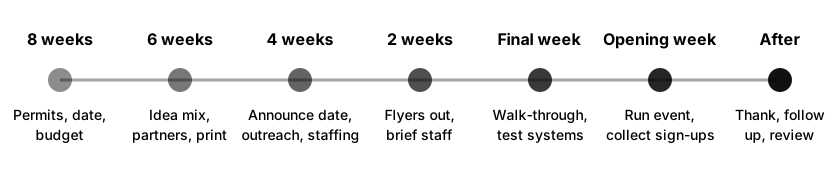
Work backward from your opening date. This outline is a planning convention from the Grand Openings Guide team, not an official standard. Stretch or shrink it to fit your timeline, and see the full steps in the step-by-step plan.
| When | Focus |
|---|---|
| About 8 weeks out | Confirm permits and inspections are on track; set the date, goal and budget categories |
| About 6 weeks out | Choose the idea mix; line up partners; order printed items |
| About 4 weeks out | Announce the date; start local outreach; plan staffing |
| About 2 weeks out | Flyers and invitations out; confirm supplies; brief staff |
| Final week | Walk-through; test systems; prepare signage |
| Opening week | Run the event; collect feedback and sign-ups |
| After | Thank people; follow up; review what worked |
The countdown planner turns your actual date into a dated list.
What does a grand opening cost? The categories
Costs depend on your location, size and choices, so no single figure is useful. Instead, budget by category. The SBA’s list of startup costs includes advertising and marketing and printed marketing materials, which cover most of a grand opening. Common categories:
- Printing and signage
- Decor
- Food and drink
- Entertainment or demonstrations
- Giveaways and samples
- Advertising and promotion
- Extra staffing hours
- Permits and insurance related to the event
- A contingency line for surprises
The SBA suggests adding a little extra, such as 10%, to cover costs you cannot predict in a break-even analysis. Use the same habit for the event. The budget estimator adds up amounts you enter yourself.
How does a grand opening differ by business type?
The goal stays the same; the format changes.
- Restaurants and cafes: tables and kitchen capacity set the limit. Start with a soft opening, then see restaurant grand opening ideas.
- Retail: foot traffic and clear offer terms matter most. See retail store ideas.
- Service businesses: consultations, open houses and demonstrations replace crowds. See small business ideas.
What mistakes waste the day?
- Opening the promotion before the operation works. A crowd amplifies every flaw.
- A vague offer. If people cannot tell what is on offer and until when, they will not come.
- No end date or terms on a promotion. The FTC’s small business advertising guide says qualifying terms must be clear and conspicuous.
- Forgetting neighbors. Parking and noise surprises cost goodwill.
- No follow-up. The week after matters as much as the day.
Where to go next
- Ideas: what to do on the day
- Promotion: grand opening marketing plan
- Printed pieces: grand opening flyer
- Steps: grand opening plan
- Not sure where to begin? Use the start here guide.
Rules for permits, signs, food service and events differ by country, state and city. Check your own city or county permit office, fire marshal and health department. This page is general information and not legal, tax or licensing advice. Read how the desk works in the editorial policy.
| Feature | Soft opening | Grand opening |
|---|---|---|
| Main purpose | Test the operation with a limited group | Announce the business and draw the public |
| Audience | Invited guests, friends, neighbors, early customers | Everyone nearby, plus press and partners |
| Promotion | Quiet, word of mouth | Loud: signage, social media, flyers, email |
| Risk if it goes wrong | Small, mistakes are expected | Public first impression |
| Typical order | First | After the operation runs smoothly |
Run a soft opening if you can, fix what it shows, then hold the grand opening when service is steady.
All Plan And Prepare guides
- Grand Opening Plan: Steps From Idea to Day
A grand opening plan in eight stages: set a goal and date, handle permits, staff and suppliers, run the day, then follow up. Includes a role list.
- How to Open a Store: Steps Before Your Opening
How to open a store, step by step: plan, choose a structure, find a location, register, get permits and insurance, then set an opening date.
Quick answers
What is a grand opening?
A grand opening is the public event, promotion or campaign that announces a new business and invites the community in. It usually happens once the business can serve customers smoothly, and it often includes offers, activities and local publicity. It is a marketing moment, so it does not replace the registration, licenses and inspections a business needs before it can legally operate.
What does grand opening mean?
Grand opening means the formal, publicly promoted start of a business, as opposed to the first day it quietly accepts customers. The word grand signals a celebration meant to be noticed. Owners use it to create a date people can remember and to give neighbors, local media and customers a reason to visit in the first days.
How long should a grand opening last?
It varies. Some businesses hold a single afternoon event, others run a weekend, and some spread offers across the first week or month. Choose the length from your goal and your staffing: a short event creates urgency, while a longer run gives more people a chance to visit. Whatever you choose, state the start and end dates clearly in every announcement.
Is a grand opening the same as opening day?
Not necessarily. Opening day is the first day a business serves customers. A grand opening is the promoted event that celebrates the business, and it can fall on opening day, a weekend later, or after a soft opening. Many owners separate them so staff can settle in before the biggest crowds arrive.
Do you need a grand opening?
No. A grand opening is optional, and some businesses simply open and grow by word of mouth. It helps most when you depend on foot traffic or local awareness, such as a restaurant, shop or salon. If your budget or staffing is thin, a smaller, well-promoted opening week can do the same job.
When should you hold a grand opening after opening?
Hold it after your operation is steady, which is the reason many owners run a soft opening first. There is no set gap and no rule, so let readiness decide. Check that staff know their roles, systems work, stock is in place and every permit you need is in hand.
Where this comes from
- SBA: Launch your business (sba.gov)
- SBA: Apply for licenses and permits (sba.gov)
- SBA: Write your business plan (sba.gov)
- SBA: Calculate your startup costs (sba.gov)
- FTC: Advertising FAQs, a guide for small business (ftc.gov)